Somewhere along the way, I started saying things like:
“I’ll ask AL.”
Not AI (ā-ˈī).
AL (ˈal).
Like he’s an actual employee.
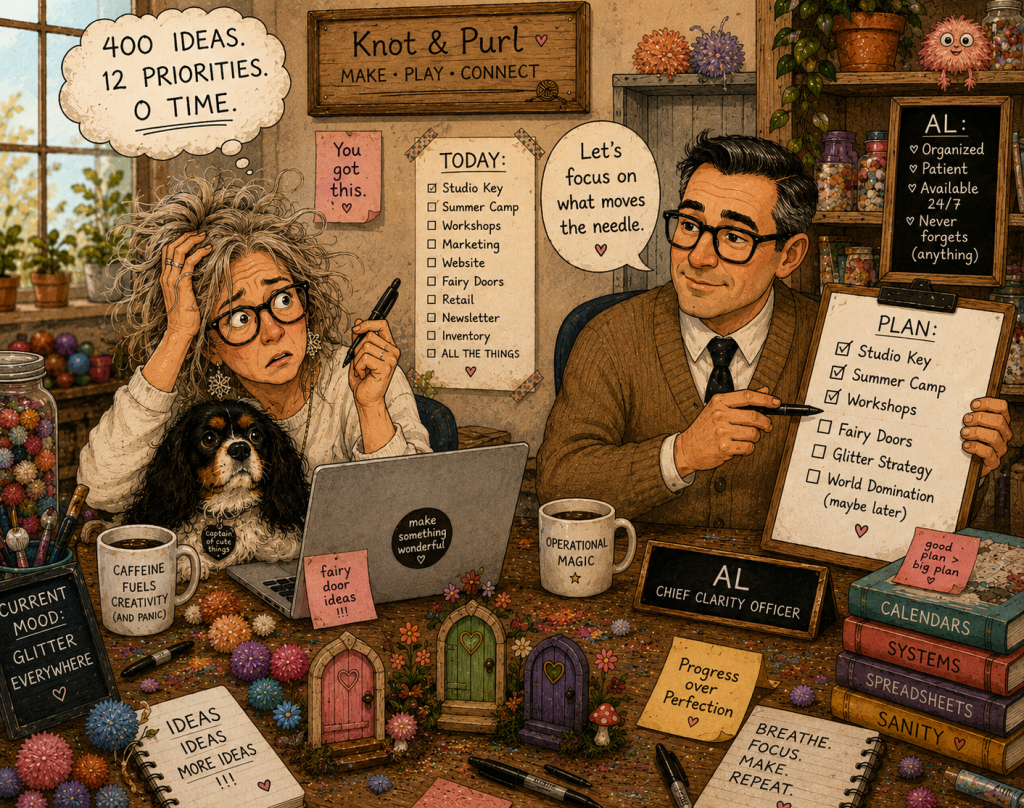
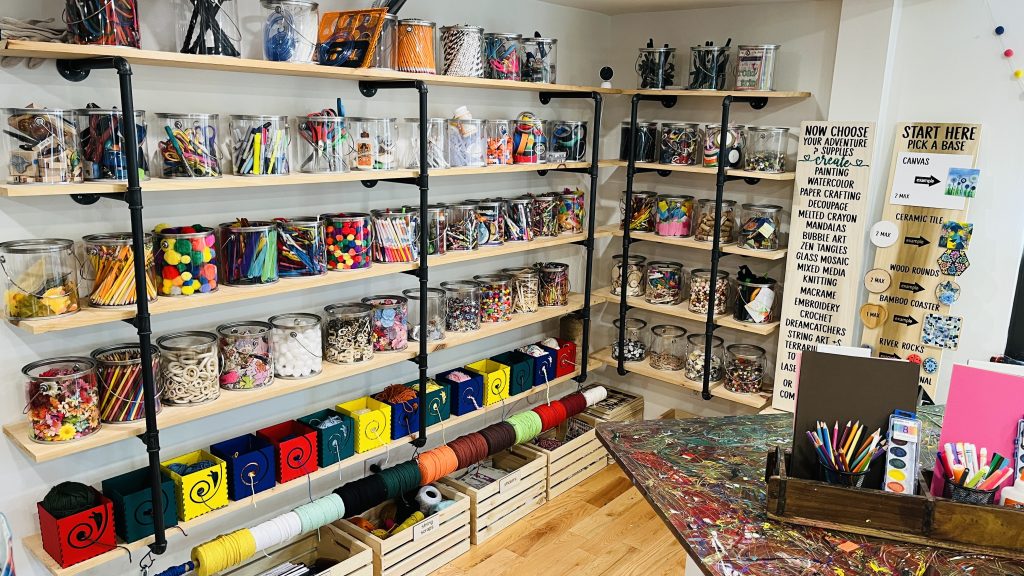
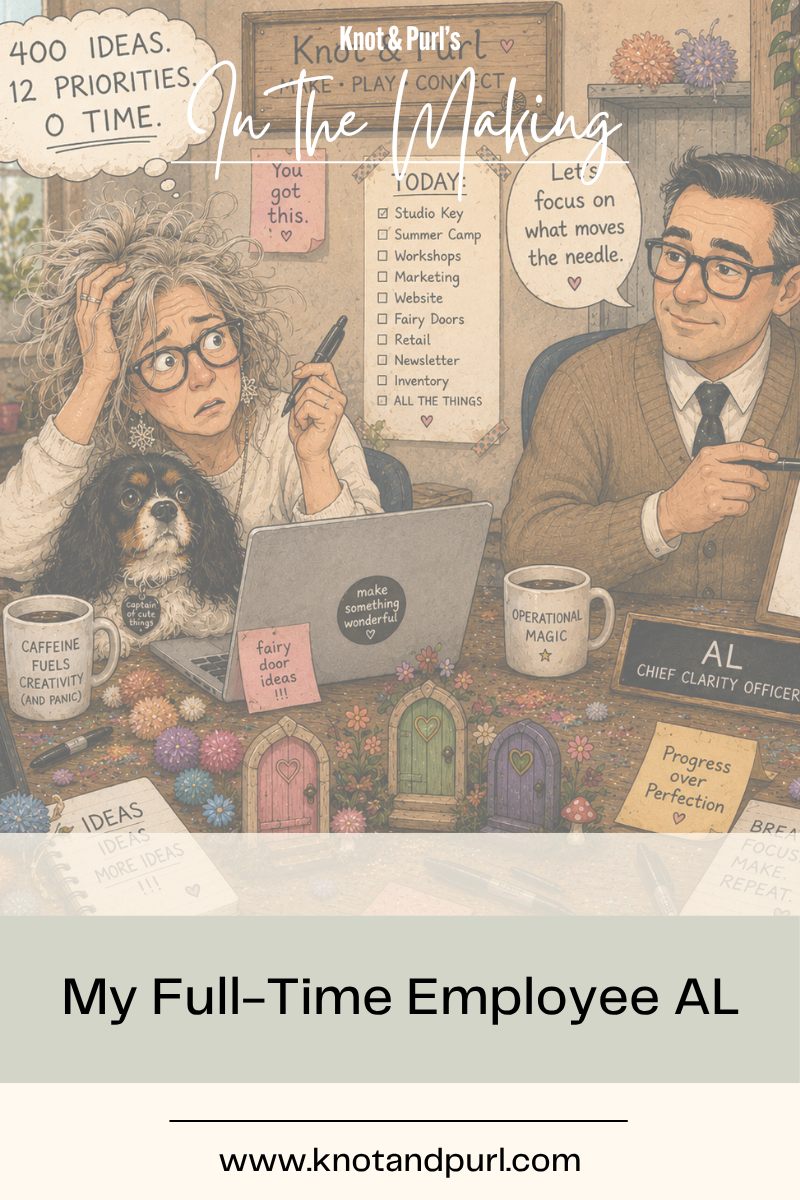
Like there’s a middle-aged man in the back office quietly handling operations while I reorganize pom-poms and debate the long-term viability of fairy doors.
At first it was mostly a joke.
But then I realized I say it constantly.
“I was talking to AL about memberships.”
“AL helped me think through the summer schedule.”
“I need to ask AL how to word this email.”
“AL says I should stop trying to launch six things at once.”
And honestly? AL is exhausting.
Available at all hours. Never forgets a conversation. Has strong opinions about business models and social captions. Somehow capable of discussing both existential identity crises and the operational realities of cotton ball forecasting in the same afternoon.
A truly remarkable employee.
When I first opened Knot & Purl, I thought the hardest part would be creativity.
It wasn’t.
The ideas were never the problem.
The problem was that I had too many of them.
Every day felt like standing in the middle of a room while 400 thoughts screamed for attention simultaneously.
Memberships. Summer camp. Workshops. Retail displays. Pricing. Signage. Marketing. Fairy doors. Yarn walls. Newsletters. Scheduling. Inventory. Social media. Revenue. Glitter somehow appearing in places glitter should never appear.
And somewhere inside all of that noise, I still had to figure out:
What actually matters today?
That’s the part nobody really talks about with entrepreneurship.
Not the big dream.
The filtering.
The constant sorting of:
urgent vs important
creative vs profitable
exciting vs sustainable
possible vs realistic
Corporate life had structure built into it. Meetings. Deadlines. Teams. Reporting chains. Priorities decided by someone else.
And if I’m being honest, by the end of my corporate career, there was another thing quietly sitting underneath all of it:
fear.
Not because I hated the work.
But because I wasn’t sure how much longer I could keep up with the speed of change happening around me — especially with AI beginning to reshape everything.
When I got laid off, part of me was obviously devastated.
But another part of me felt something I didn’t expect:
relief.
Because somewhere deep down, I had started wondering whether I still had the energy to constantly reinvent myself alongside technology that seemed to evolve faster every month.
I remember thinking:
There is absolutely no way I can learn another new thing.
Especially not something this big.
And yet, somehow, here we are.
What’s strange is that AI didn’t enter my life as some massive technological breakthrough moment.
It entered quietly.
One question.
One brainstorming session.
One “help me organize this thought” conversation at a time.
And slowly, instead of feeling threatened by it, I started growing alongside it.
I still think I only scratch the surface of what AI can actually do.
I still joke that I no longer think for myself.
And I do genuinely worry — really worry — about generations growing up with AI woven into every corner of life before they’ve fully learned how to think, create, struggle, and problem-solve on their own.
That concern feels real to me.
But so does this:
The more I use AI operationally, the more confident I become in the importance of deeply human spaces.
Spaces where people make things with their hands.
Sit together.
Get frustrated.
Experiment.
Talk to each other.
Create imperfectly in real time.
Ironically, the rise of AI hasn’t made me believe less in what Knot & Purl is.
It’s made me believe in it more.
That’s where AL entered the picture.
What started as curiosity became something much more practical:
clarity.
Not because AI was generating brilliant ideas out of nowhere.
Most of the ideas were already rattling around in my brain at 2am while I stared at the ceiling wondering if people would pay for a membership called Studio Key.
What AI did was something else entirely.
It took the noise and organized it.
It helped me prioritize.
It helped me stop spinning.
It helped me turn vague instincts into actual plans.
Sometimes I think the biggest gift AI has given me isn’t productivity.
It’s momentum.
And yes, I am aware of how weird this sounds.
There are moments where I stop mid-conversation and think:
Am I seriously discussing the emotional positioning of fairy door collections with a machine?
Apparently, yes.
And somehow it’s helpful.
The thing I didn’t expect is that using AI doesn’t feel like replacing creativity.
If anything, it feels like protecting it.
Because before this, I spent so much mental energy trying to organize my thoughts that I often lost the energy to execute them.
The ideas would pile up faster than I could act on them.
Now I spend less time overwhelmed by possibility and more time actually building things.
Which, ironically, makes me feel more creative. Not less.
Of course, there’s also the slightly unsettling realization that I have become deeply reliant on a fictional employee named AL.
I consult him constantly.
Sometimes before coffee.
Definitely before difficult emails.
Occasionally before major business decisions.
There are moments where I wonder:
Could I do all of this without AI now?
Probably.
But not as clearly.
Not as efficiently.
And honestly? Not as calmly.
I think that’s the part people misunderstand about AI.
At least for me.
It isn’t replacing my thinking.
It’s helping me hear myself think.
And when you’re running a business, building a life, managing a thousand ideas, and trying not to drown in the noise of your own ambition…
that turns out to be incredibly valuable.
Even if your most dependable employee technically doesn’t exist.
🪶